Detailed Specifications
Modular 3D Printed Design
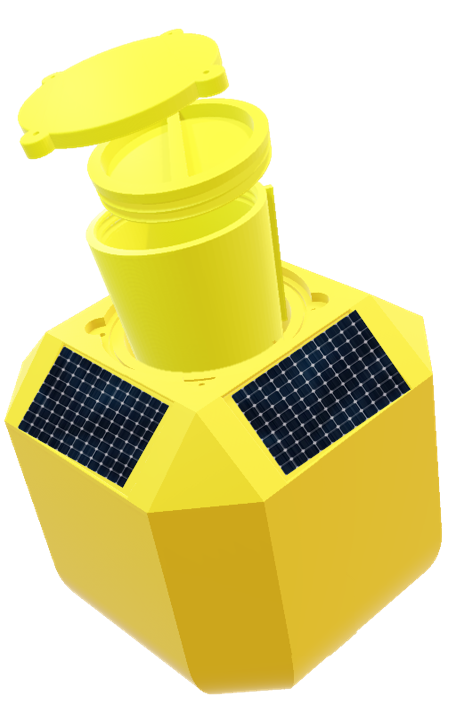
The Smart Buoy features a complex, modular structure manufactured using 3D Printing (PLA+). To ensure longevity, the body is treated with Dichtol for complete waterproofing.
Key Components
- Main Body: Angled slots for 1W solar panels (latitude-optimized).
- Sealed Chamber: Base housing for battery & internal channels.
- Removable Cylinder: Core electronics, designed for quick swap.
Durability
Airtight waterproofing via specialized lid & O-ring mechanism. Secure tethering via anchors calculated for specific buoyancy.
Dual-Circuit Sensing Subsystem
Offshore (Buoy)
- IMU (9-axis): Arduino NANO 33 BLE for wave analysis.
- Water Temp: Waterproof DS18B20 sensor.
Onshore Station
- Wind: Hall sensor anemometer & compass.
- Air Quality: BOSCH BME688 (Gas, Humidity, Temp).
- UV Index: Radiation sensor for tourist safety.
Robust IoT Architecture
Short-Range (Buoy Shore)
BLE Encoded PHY (Range: ~200m). Features MESH Failover to relay data if direct connection drops.
Long-Range (Shore Cloud)
Aggregated data sent via GPRS (IPv4/REST). Ensures coverage in remote areas with legacy infrastructure.
Advanced Signal Processing
Raw IMU data is transformed into wave metrics (h, T, V) through a 3-stage pipeline:
Filtering
Low-pass & complementary filters isolate wave motion from gravity.
Spectral Analysis
FFT converts data to frequency domain for wave height distribution.
Estimation
Kalman filter & Rauch-Tung-Striebel smoothing for trajectory.
Autonomous Power Management
Self-sustainable power management system designed for continuous autonomy.